The Engineering Philosophy Behind FIREWALL
The design principles that guide FIREWALL are drawn directly from an analysis of infrastructure failure modes documented across thirty years of California wildfire events. Rather than optimizing for normal operating conditions — which is how most civil infrastructure is designed — FIREWALL was engineered specifically for the worst-case scenario: a major wildfire event occurring simultaneously with a grid outage, extreme wind conditions, degraded municipal infrastructure, and potentially restricted access roads.
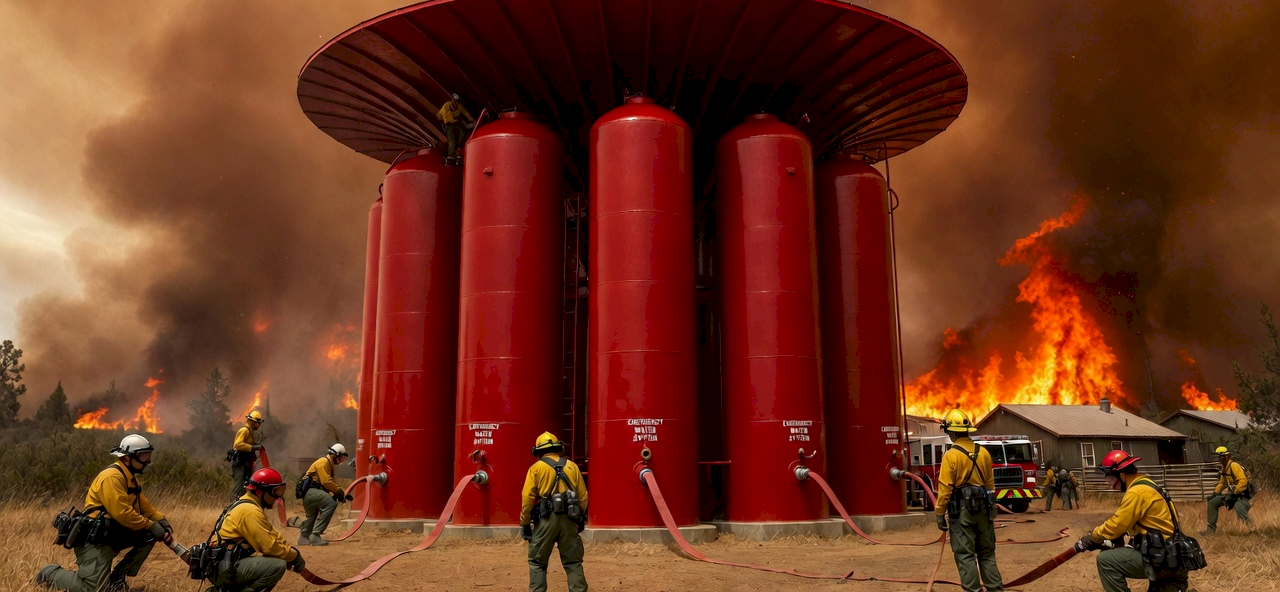
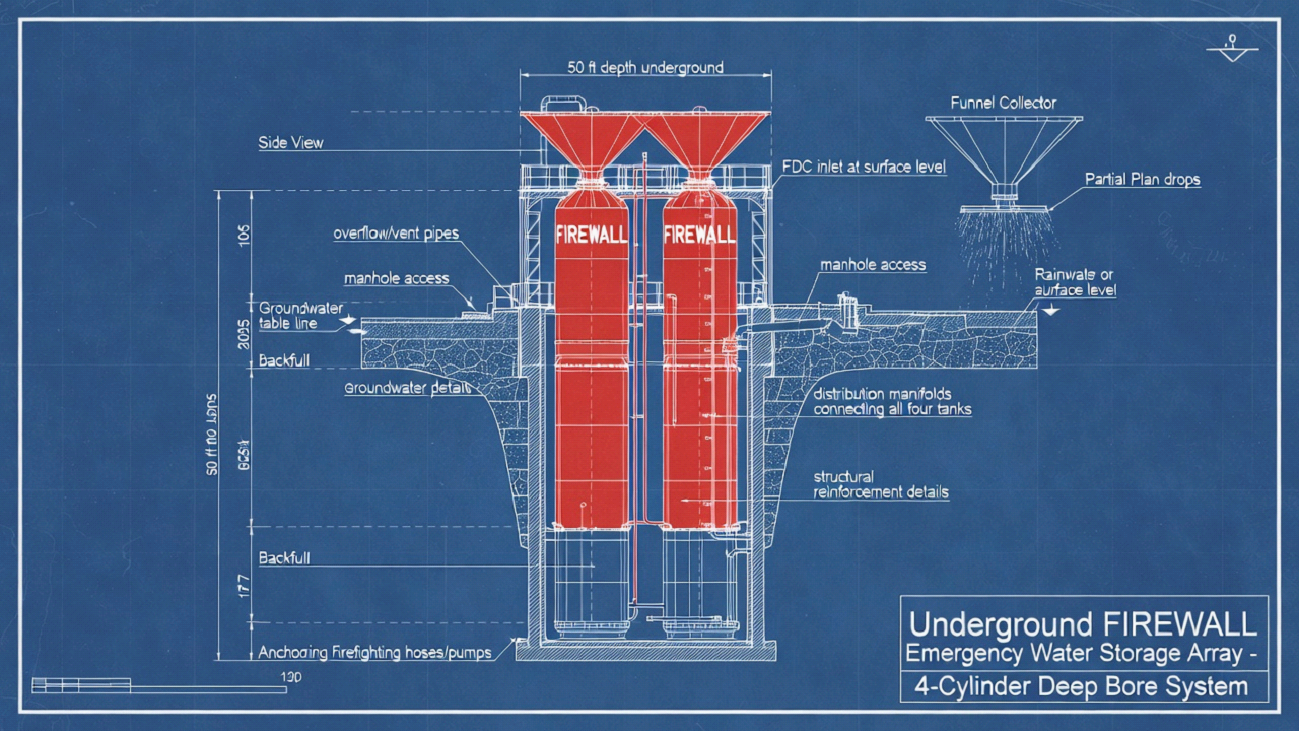
Under those conditions, standard water infrastructure fails. FIREWALL is designed not to fail. Every system component has redundancy. Every power source has a backup. Every pump has an automatic failover. The monitoring and communications systems operate on dedicated cellular connections independent of local telephone infrastructure. Even the physical installation method — deep burial with concrete anchoring — protects against the soil liquefaction and slope failure that can expose or damage above-grade infrastructure during the earthquakes that frequently accompany or follow major fire events.
Dual-Use Capability: Five Threats, One Infrastructure Investment
FIREWALL was designed for wildfire, but its capabilities address five distinct threat vectors that collectively represent California's most pressing infrastructure vulnerabilities. This dual-use design means that every FIREWALL cluster provides value not just during fire season, but across the full spectrum of California emergency scenarios.
The five threat vectors FIREWALL addresses are:
- Wildfire water supply failure — The primary design objective. FIREWALL provides pressurized, grid-independent water delivery at fire-department-compatible flow rates regardless of municipal infrastructure status.
- Post-fire water contamination — Sealed steel cylinders cannot be contaminated by benzene from melted plastic pipes. In the days and weeks following a wildfire, FIREWALL provides the only safe water source available in communities where the municipal system is compromised.
- Earthquake response — When earthquakes rupture water mains — a common occurrence in seismic events that exceed Magnitude 5.5 — FIREWALL clusters provide neighborhood-scale water supply for both firefighting and civilian emergency use while main repair takes days to weeks.
- PSPS resilience — FIREWALL operates entirely without grid power. Communities served by FIREWALL clusters maintain firefighting capability even during extended PSPS events that may last four to seven days.
- Drought emergency supply — AWG units provide a small but continuous water supply that can be critical for isolated communities during multi-year drought conditions when groundwater levels drop below pump range. FIREWALL clusters with AWG can serve as neighborhood-scale emergency water points during declared drought emergencies.
Compatibility with Existing Fire Department Operations
A critical design constraint for FIREWALL was seamless integration with existing fire department equipment and procedures. No new specialized equipment is required. No additional training is required beyond familiarization with the connection points and monitoring system. Every engine company in California that is qualified to use a hydrant or draft from a static water source can use a FIREWALL cluster without modification.
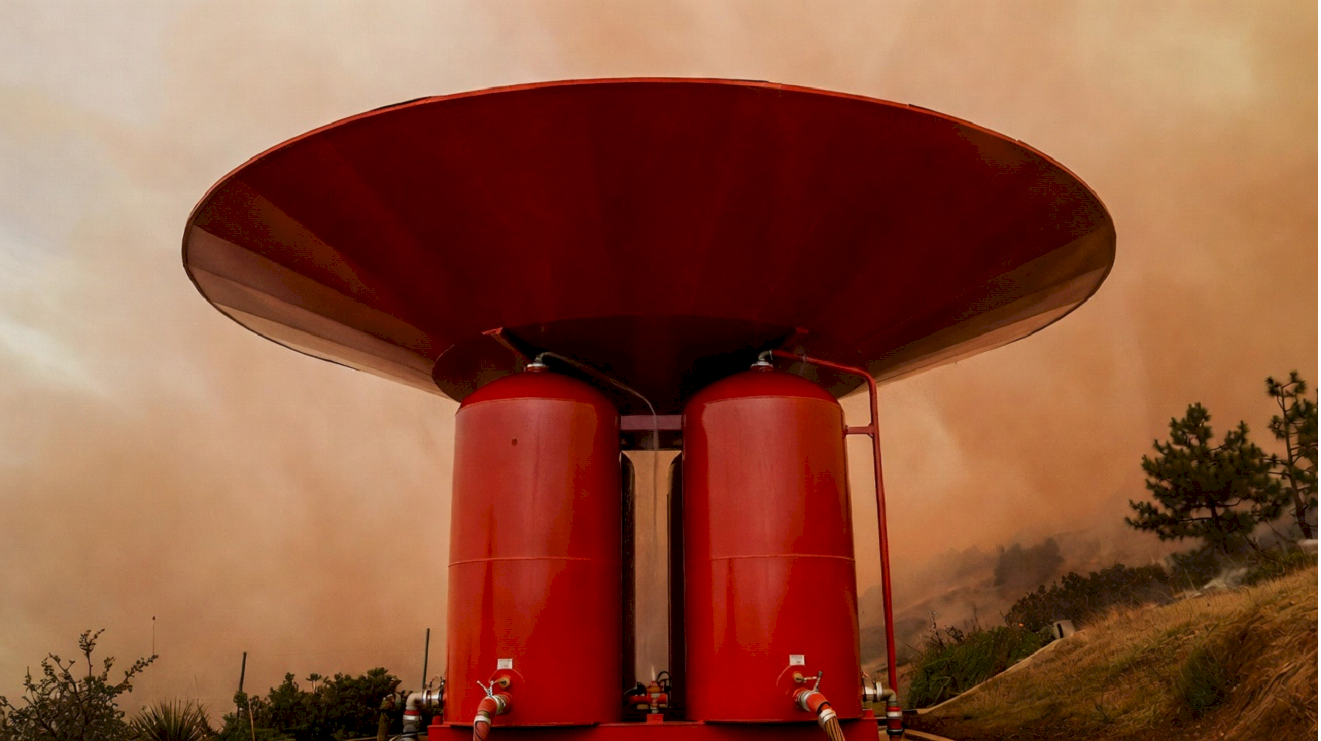
Connection fittings are standard California Storz specifications in both 2½-inch and 4-inch configurations. The manifold supports four simultaneous connections. Pump output pressure at the manifold connection points is maintained at 60–80 PSI — within the optimal range for standard attack lines — regardless of how many engines are connected and regardless of the local elevation difference between the cluster and the engine.
The IoT monitoring interface is compatible with CAD (Computer-Aided Dispatch) systems used by major California county OES offices. Incident commanders can query FIREWALL cluster status through the same dispatch interface they use to request mutual aid, locate resources, and track unit assignments. The system integrates with the National Incident Management System (NIMS) resource tracking framework as a Type I water tender equivalent.
Installation and Maintenance
Installation of a FIREWALL cluster requires excavation to a depth of 30–100 feet depending on soil conditions and cluster size, concrete anchoring of the steel cylinders, installation of the manifold assembly and pump systems at a surface access vault, and connection of the solar array and battery bank to the pump control system. Initial filling is accomplished via water tender or municipal supply connection. Typical installation time for an 8-cylinder cluster is 14–21 working days including site preparation, excavation, installation, testing, and commissioning.
Annual maintenance requirements consist of pump system inspection and lubrication, solar panel cleaning, battery capacity testing, and IoT sensor calibration. Total annual maintenance time per cluster is estimated at 8–12 hours. Pump systems are rated for 15-year minimum service life between major overhauls. Steel cylinder coating systems carry a 25-year warranty.
"FIREWALL is the infrastructure that should have been deployed after the Oakland Hills fire, after the Tubbs fire, after the Camp fire. The technology has always existed. The will to deploy it at scale has not."
The FIREWALL program addresses this gap directly. Through the phased deployment program described in the Investment section, FIREWALL moves from pilot installation to statewide coverage in five years — at a total cost that represents a fraction of the emergency spending that would be required to respond to even a single major fire event of the scale California has experienced repeatedly in the past decade.