The Problem That Never Gets Solved
In the early hours of January 7, 2025, fire commanders directing suppression efforts in Pacific Palisades received a message that no incident commander ever wants to hear: their hydrants were running dry. Three million-gallon reservoirs that had been completely full at ignition were drained within fifteen hours. Pump stations that should have maintained pressure across the water distribution network had lost power and could not be restarted. Engine crews were told to "pick their best targets" — not because Los Angeles lacked water, but because there was no water where the fire was burning.
It was, by any measure, a catastrophic failure of water infrastructure. But it was not a surprise. The same failure had occurred in Oakland in 1991, when seventeen pump stations lost power and firefighters watched helplessly as the Diablo winds drove flames through residential neighborhoods. It happened in Santa Rosa in 2017, when the Tubbs Fire moved so fast that pressure drops rendered hydrants useless across wide sections of the city. It happened in Paradise in 2018, when the Camp Fire overwhelmed the water system so completely that residents were on a "Do Not Drink" advisory for eighteen months after the fire was extinguished — not because of the flames, but because the heat had melted plastic distribution pipes and released benzene into the water at eighty times the hazardous waste threshold.
"Firefighters in Pacific Palisades were told to pick their best targets — not because there wasn't water in Los Angeles. Because there wasn't water where the fire was."
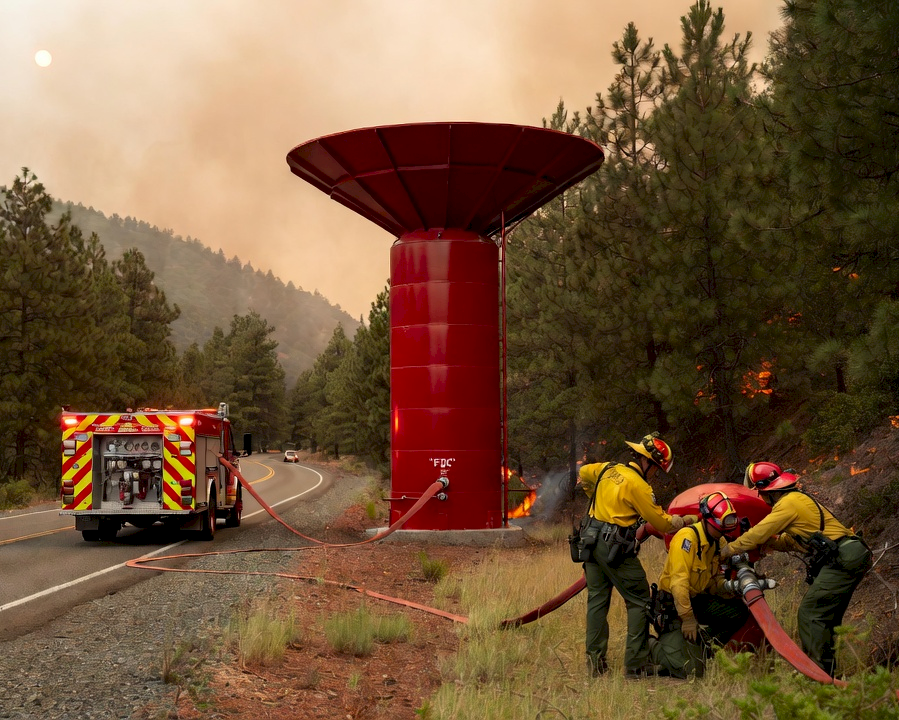
Every post-incident investigation reaches the same conclusions. Every after-action report identifies the same vulnerabilities. Every fire chief who has survived one of these events advocates for the same solution: distributed, grid-independent water storage positioned in advance at high-risk locations, capable of delivering pressurized water to fire department equipment without relying on a functioning electrical grid or municipal distribution network. The infrastructure exists in theory. It has never been built at scale.
Why Municipal Systems Fail in Wildfire Conditions
To understand why this failure repeats itself, it helps to understand how municipal water systems are actually designed. Water distribution networks are engineered for daily demand — filling bathtubs, running dishwashers, irrigating lawns, and serving commercial users. They are built with some reserve capacity for firefighting, but that reserve is calculated for structure fires: single buildings requiring sustained suppression for minutes to hours. They are not designed for wildfire-scale events where dozens or hundreds of structures ignite simultaneously across a wide geographic area.
When a wildfire enters a residential neighborhood, demand on the water system spikes to levels it was never designed to handle. Every hydrant connected to every engine company draws from the same pressurized network at the same time. Storage tanks that might last days under normal demand conditions drain in hours. Pump stations that elevate water to hilltop communities — the exact communities at highest wildfire risk — require continuous electrical power to maintain pressure. When those stations lose power, which happens routinely during the high-wind conditions that drive major fires, water pressure in the distribution system drops precipitously. Hydrants that had normal pressure at the beginning of a shift have no pressure two hours later.
The physics of this failure is straightforward and well-documented. What is less well understood is how consistently this failure has been allowed to repeat. The Oakland Hills Fire of 1991 generated dozens of recommendations for distributed water storage and grid-independent infrastructure. Those recommendations were studied, published, and largely implemented as pilot projects that never scaled. The Camp Fire of 2018 generated a new wave of recommendations, many of them identical. The January 2025 fires generated a new round of emergency appropriations and task forces — and the same recommendations appeared again in the post-incident reports, as if they had never been made before.
The PSPS Compounding Factor
California's wildfire water crisis has a second dimension that does not receive enough attention: the Planned Safety Power Shutoff, or PSPS. Since 2019, Pacific Gas and Electric, Southern California Edison, and San Diego Gas and Electric have used preemptive power shutoffs as a tool to reduce ignition risk during high fire-weather conditions — the exact conditions under which a wildfire is most likely to occur and most difficult to control.
In October 2019, PG&E shut off power to more than three million people across thirty counties for four to seven days. The stated purpose was fire prevention. The unexamined consequence was that the communities at highest fire risk were simultaneously deprived of the electrical power that their water pump stations require to function. A community whose power has been cut by a PSPS event has, by definition, reduced water delivery capability — at precisely the moment when fire risk is at its peak.
Fire chiefs have identified the PSPS scenario as their worst-case planning challenge: a major ignition event during a PSPS cutoff in a WUI community. The combination of dry conditions, high winds, no grid power, and degraded water pressure creates a situation where even a small ignition can become catastrophic before sufficient resources can be marshaled. This scenario is not hypothetical. It describes the conditions that preceded the Camp Fire in 2018, when power lines downed by wind sparked an ignition during a period of extreme fire danger. It describes the general conditions during the January 2025 events, when infrastructure degraded across multiple service areas simultaneously.
The Water Contamination Legacy
Beyond the immediate threat to structures and lives, wildfire water system failures leave a contamination legacy that extends far beyond the fire perimeter. When plastic water distribution pipes are exposed to the extreme heat of a wildfire, they do not simply melt — they off-gas volatile organic compounds, including benzene, into the water trapped inside them. That benzene-contaminated water then circulates through the distribution system, contaminating pipes and plumbing fixtures in buildings that may not have been directly affected by the fire.
In Paradise, California, the post-Camp Fire water contamination problem was so severe that the city's water system was declared unsafe for human consumption for eighteen months. Testing found benzene at concentrations of up to forty thousand parts per billion — eighty times the hazardous waste designation threshold and more than four thousand times the drinking water maximum contaminant level. Residents who returned to salvageable homes could not use their taps, could not wash their clothes in city water, and could not bathe without risk of exposure to a known carcinogen. The cleanup cost tens of millions of dollars and required replacing hundreds of miles of distribution piping.
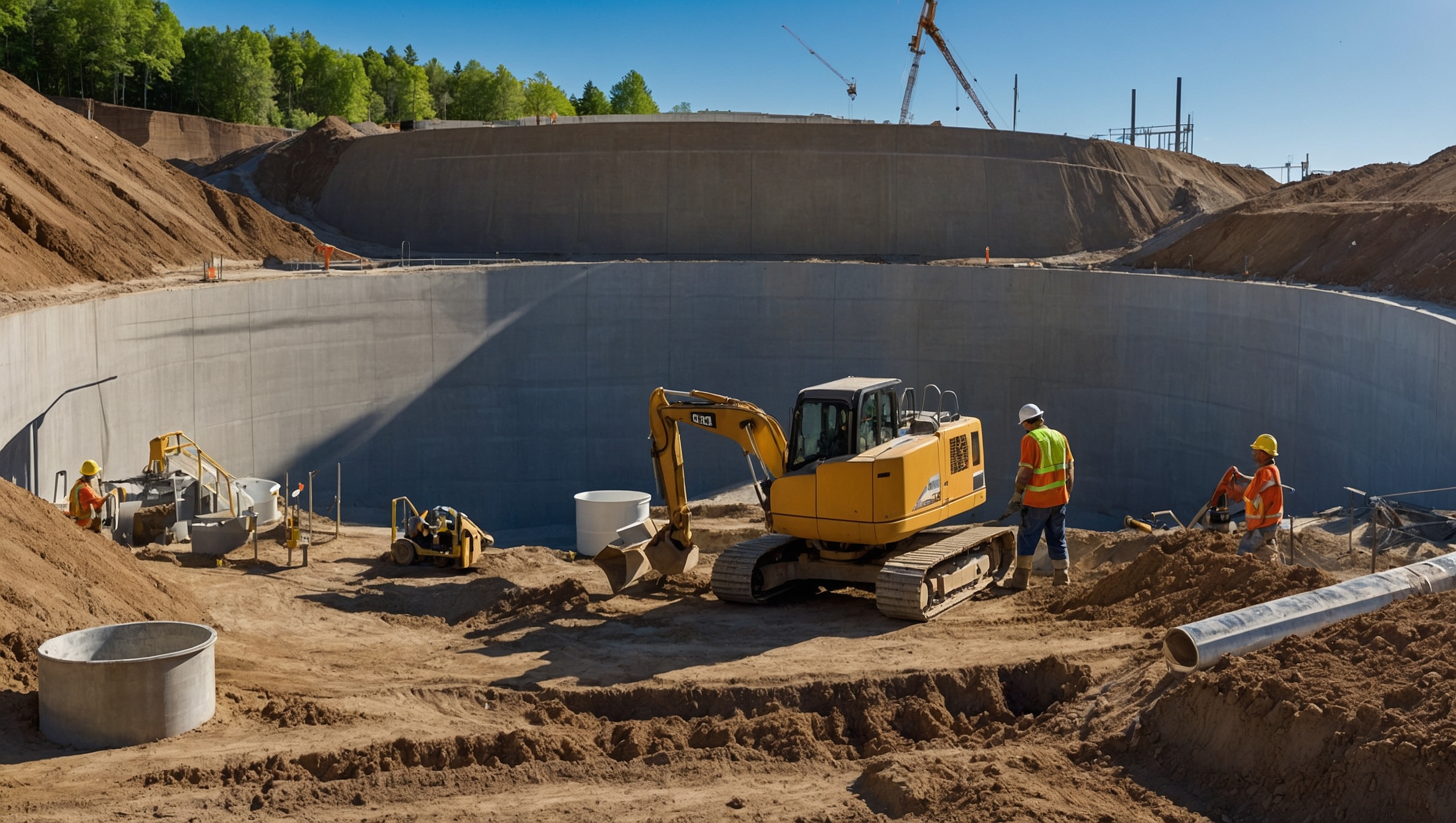
FIREWALL's sealed steel cylinders are immune to this contamination mechanism. Steel does not off-gas toxic compounds under heat. A FIREWALL cluster buried twenty to one hundred feet underground is protected from the temperatures that cause plastic pipe failure. In the aftermath of a wildfire that has destroyed the municipal distribution network, FIREWALL provides the only clean water available in the affected community — a capability that is simultaneously critical for public health and entirely absent from current infrastructure planning.
A Solvable Problem
The frustrating reality of California's wildfire water crisis is that it is not a particularly difficult engineering problem. The physics of underground water storage, solar-powered pumping, and atmospheric water generation are well understood. The components exist. The installation methods are established. The only missing element has been a serious commitment to deploying them at scale before the next fire event.
FIREWALL represents that commitment. It is not a research project or a pilot program in search of technology — it is a deployment program for infrastructure that is already proven, already manufacturable, and already compatible with existing fire department equipment and procedures. The question is not whether it will work. The question is whether California will build it before the next community burns while its hydrants run dry.
The Pattern Cannot Continue
California has appropriated more than $7 billion in emergency and mitigation funds following the fires of 2017, 2018, and 2025 — and yet the fundamental infrastructure vulnerability remains unaddressed. FIREWALL proposes to solve it permanently, at a cost of less than 1% of the total emergency spending those fires have generated.